
our blog
Texas Estate Planning Attorney Blog
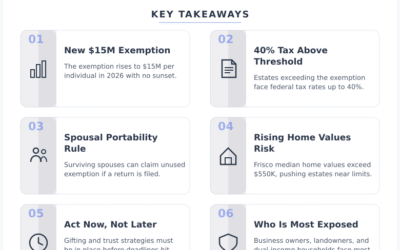
The Federal Estate Tax Just Changed in 2026 – What Prosper and Frisco Families Need to Do Before It Costs Them
The federal estate tax exemption is set to drop from approximately $13.99 million to roughly $7 million per individual on January 1, 2026, when the Tax Cuts and Jobs Act provisions sunset. For families in Prosper, Frisco, and throughout Collin County, this change creates real exposure – especially given rising real estate values, business interests, and life insurance death benefits that many households do not factor into their total estate size. Texas carries no separate state estate tax, which is an advantage, but does nothing to reduce federal estate tax liability. Gifts made before December 31, 2026 are protected under current IRS guidance, meaning lifetime gifting and irrevocable trust strategies funded now can permanently reduce taxable estate values. A six-step action plan covers asset valuation, document review, annual exclusion gifting, trust evaluation, financial coordination, and portability filings. A document checklist guides families on what to bring to a consultation. A comparison table confirms that neighboring states – Oklahoma, New Mexico, Arkansas, and Louisiana – also have no state estate tax, making the federal sunset the primary risk across the region. The post closes with seven FAQs addressing exemption amounts, Texas state tax rules, gifting strategy, trust timelines, and the cost of inaction.
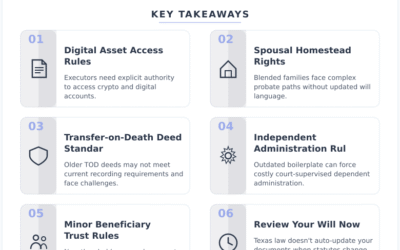
Your Will Is Probably Outdated – 5 Texas Law Changes from 2026 That Affect Collin County Estates Right Now
Texas made several significant legal changes in 2026 that directly affect how wills, Transfer-on-Death deeds, and beneficiary designations are interpreted in Collin County probate courts. The five key changes covered include expanded digital asset access rules requiring explicit executor authority over cryptocurrency and online accounts, revised spousal homestead rights language that creates new risks for blended families and community property situations, updated TOD deed recording requirements that may invalidate older filings, a raised threshold for independent administration that can force slower court-supervised probate when older boilerplate language is used, and tightened rules around how assets pass to minor beneficiaries without a formal trust in place. The post compares updating an existing will through a codicil versus drafting a new document entirely, including a cost comparison table with 2026 Texas market ranges. A step-by-step action plan walks readers through locating documents, checking execution dates, mapping current assets, and scheduling a legal review. Common mistakes covered include naming a deceased executor, failing to update after divorce, ignoring retirement account beneficiary forms, and omitting digital asset clauses. The Greg Hall Law Firm in Prosper, Texas serves Collin County residents including Frisco, McKinney, Allen, Plano, Celina, and Fairview. A full FAQ section addresses costs, timelines, DIY risks, and homestead concerns under current Texas law.
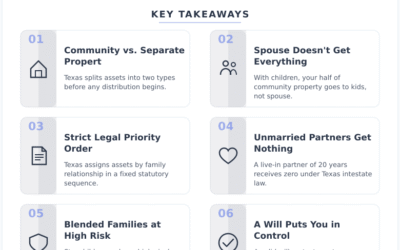
Died Without a Will in Prosper or McKinney? Here’s Exactly What Texas Law Does With Your Assets
When someone dies without a will in Prosper, McKinney, or anywhere in Collin County, Texas intestate succession law takes over – and the results often shock surviving families. The most critical misconception is that a spouse automatically inherits everything. Under Texas community property rules, if the deceased had children, the surviving spouse keeps their own half of community property but the deceased’s half passes to the children. Unmarried partners receive nothing, and stepchildren are legally invisible without a valid will. The post walks through the exact priority order Texas courts follow, from married-with-children scenarios to single individuals with no immediate family. A direct comparison between intestate succession and a valid will shows the significant cost, timeline, and control differences – intestate probate in Collin County typically runs 9 to 18 months. A six-step action plan covers how to navigate probate through the Collin County Probate Court in McKinney, including which documents families need, how debts are settled before heirs receive anything, and how digital assets are increasingly becoming contested claims in 2026 filings. Common mistakes – like distributing assets before debts clear or assuming joint accounts transfer automatically – are addressed with practical guidance. The post serves residents of Prosper, McKinney, Frisco, Allen, and surrounding Collin County communities and concludes with a direct call to action from The Greg Hall Law Firm in Prosper, Texas.
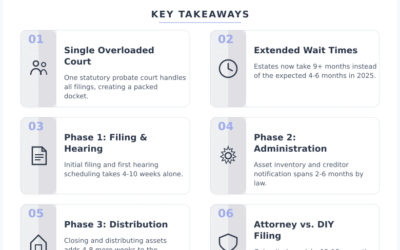
Collin County Probate Court Is One of the Busiest in Texas – Here’s How That Affects Your Family’s Timeline
Collin County probate court handles all estate filings for one of the fastest-growing counties in Texas – over 1.1 million residents in 2026 – and a single statutory probate court is managing that entire caseload. Families expecting a four-to-six-month process are regularly seeing timelines of nine months or longer. The post breaks down exactly why backlogs occur, what the three phases of probate look like with realistic 2026 timeframes, and how choosing the right type of proceeding (full administration vs. muniment of title vs. small estate affidavit) can significantly cut the wait. A side-by-side comparison of DIY filing versus attorney-assisted filing shows the real-world timeline and risk differences. An action plan covers the six steps families should take immediately after a loss, followed by a document checklist for everything needed before the first court filing. Common mistakes that make delays worse – including waiting too long to file and submitting incomplete inventories – are laid out plainly with guidance on how to avoid each one. The FAQ section addresses costs (Collin County filing fees run $355-$400 in 2026), intestacy rules, and when an attorney genuinely makes a difference. The Greg Hall Law Firm, based in Prosper, Texas, serves families throughout Collin County including McKinney, Frisco, Allen, Plano, and Celina.
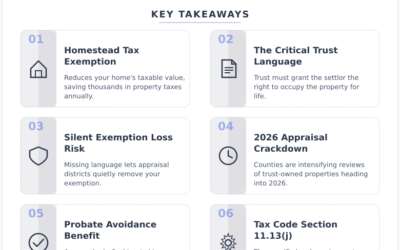
Homestead Property Tax Exemption and Revocable Trusts in Texas: The 2026 Rule That Could Cost You If Your Trust Lacks This One Line
Texas law allows homeowners to hold their primary residence in a revocable living trust and still qualify for the homestead property tax exemption – but only if the trust document contains specific occupancy language required under Texas Tax Code Section 11.13(j). Without that language, appraisal districts can remove the exemption, potentially costing homeowners hundreds to thousands of dollars per year. Heading into 2026, appraisal districts across Collin County and the broader Texas region are intensifying their verification processes for trust-held properties. Common mistakes include transferring the deed without re-filing for the exemption, using generic trust templates that lack Texas-specific language, and failing to submit a trust certification to the appraisal district. The fix is usually a straightforward trust amendment rather than a complete restructuring. Homeowners with over-65 or disability exemptions face the same risk. The Greg Hall Law Firm, located in Prosper, Texas, helps residents review and correct their trust documents before exemption removal becomes a problem.
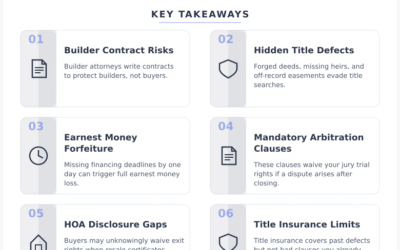
Buying a Home in Prosper or Frisco in 2026? Here Are the Title and Contract Traps Most Buyers Don’t See Until It’s Too Late
Buyers in Prosper and Frisco entering the 2026 market face specific title and contract risks that aren’t obvious until it’s too late to walk away cleanly. Builder contracts are written to protect developers, not buyers, and many include mandatory arbitration clauses, limited cancellation rights, and as-is addenda that strip away negotiating leverage. Title insurance protects against past defects but won’t cover Schedule B exceptions the buyer already agreed to, making it critical to read the title commitment before closing day. Six specific contract traps are outlined, including unilateral builder termination rights, HOA disclosure timing gaps, and survey exceptions that hide encroachments. A comparison table breaks down the cost and coverage of owner’s title policies, lender’s policies, title searches, and surveys in 2026 dollars. A six-step protection checklist walks buyers through contract review, survey ordering, lien verification, and deadline tracking. The post includes a document checklist buyers should bring to a legal consultation, and a full FAQ section covering title defects, the Texas option period, builder contract exit rights, and Collin County title search timelines. The Greg Hall Law Firm in Prosper, Texas serves buyers throughout Collin County including Frisco, McKinney, and Celina.
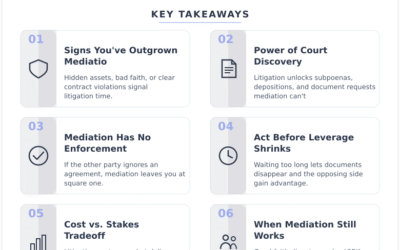
Partner Dispute, Breach of Contract, or Bad Deal in North Texas? When Your Business Needs a Litigation Attorney, Not a Mediator
North Texas business owners facing partner disputes, contract breaches, or bad business deals often wrestle with whether to pursue mediation or go straight to litigation. Mediation works when both sides are genuinely willing – but it has no enforcement power and fails completely against bad-faith actors. This post breaks down the clearest signals that your dispute has moved past mediation, including unresponsive counterparties, clear contract violations, approaching legal deadlines, and fraud. A direct comparison table shows cost ranges, timelines, and enforceability differences between mediation and formal litigation in 2026. The post covers the most common commercial disputes appearing in Collin County and Denton County courts – breach of contract, LLC member disputes, and business purchase misrepresentation – and explains Texas statutes of limitations that apply to each. A five-step action plan tells business owners exactly what to do from the moment a dispute escalates, including evidence preservation, damages calculation, and why consulting an attorney before responding to the other party is critical. A pre-consultation document checklist and a section on the four most common mistakes that hurt cases before they start round out the practical guidance. The Greg Hall Law Firm is based in Prosper, Texas and serves the broader North Texas business community.
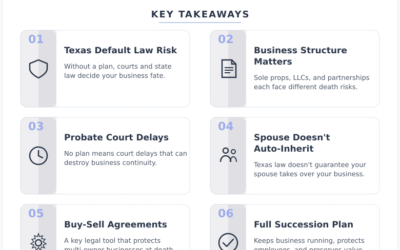
What Happens to Your North Texas Business When You Die – and Why Most Owners in Prosper Have No Plan
Most North Texas business owners in Prosper and Collin County have spent years building real companies but have never addressed what happens to those companies when they die. Texas law does not automatically hand your business to your family. Sole proprietorships dissolve at death. LLCs without succession language face potential court-ordered dissolution under the Texas Business Organizations Code. Partnerships without buy-sell agreements can leave surviving partners with more rights than a spouse. The article breaks down what each business structure faces under Texas default law, why that outcome almost never matches what owners intend, and which documents actually protect the business – including buy-sell agreements, succession clauses in operating agreements, durable powers of attorney, and revocable trusts. A cost comparison table shows general Texas market pricing for different planning approaches in 2026, ranging from roughly $1,500 for a standalone buy-sell agreement to $8,000 or more for a full succession plan with trust integration. A practical action plan and pre-consultation checklist give owners a concrete starting point. The piece also flags the urgency of acting before potential federal estate tax changes expected in 2026. The Greg Hall Law Firm, located at 290 South Preston Road in Prosper, Texas, serves business owners throughout Prosper, Frisco, McKinney, Allen, Celina, and surrounding communities.
Contesting a Will in Texas in 2026: What Collin County Families Need to Know Before They Go to Court
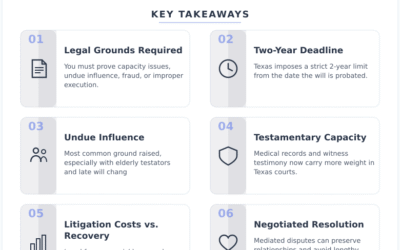
Contesting a will in Texas requires more than a family disagreement – Texas law limits challenges to specific legal grounds including lack of testamentary capacity, undue influence, fraud, improper execution, and revocation. Collin County families face a hard two-year deadline running from the date the will is admitted to probate, not the date of death, and missing it ends the case entirely. The post breaks down when formal litigation makes sense versus when negotiated resolution is a smarter path, with a comparison table showing typical costs ranging from $3,000 for mediation to $75,000 or more for full litigation in 2026. A six-step action plan walks readers through confirming their deadline, gathering medical and financial records, confirming legal standing, and understanding what discovery looks like in Collin County Probate Court. Common mistakes covered include filing on emotion without evidence, losing key records in the weeks after a death, and misunderstanding that being excluded from a will does not automatically create a legal claim. The FAQ section answers the most searched questions on Texas will contests, including who qualifies as an interested person, what undue influence actually means in court, and how holographic wills are handled. The post serves families in Prosper, McKinney, Frisco, Allen, Plano, Celina, and Anna, and connects readers to The Greg Hall Law Firm in Prosper, Texas for a confidential case assessment.
Why Every Young Family Moving to Prosper, Celina, or McKinney Should Have an Estate Plan Before They Unpack
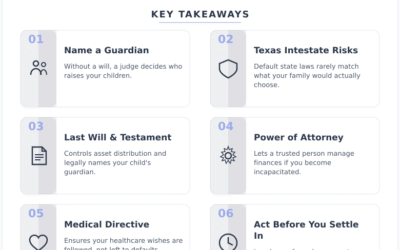
Young families relocating to Prosper, Celina, or McKinney are often so focused on closing on a home and enrolling kids in school that legal planning falls off the list entirely. This post makes the case that estate planning belongs on the moving checklist, not the someday list. It explains what Texas intestate succession law actually does to families without a will – including how separate property can be split between a surviving spouse and minor children, creating court-supervised complications most families never anticipate. The post covers the five core documents every young Texas family needs: a will, durable power of attorney, medical power of attorney, HIPAA authorization, and a directive to physicians. It includes a comparison table of document types with 2026 cost ranges, a six-step action plan, and a pre-consultation checklist families can use before meeting with an attorney. Key distinctions between wills and revocable living trusts are addressed in plain language. The FAQ section tackles common questions about out-of-state wills, guardian naming, Texas’s lack of a state estate tax, and the federal estate tax changes expected in 2026. The post grounds everything in the specific context of Collin County’s rapid growth and the practical reality that the weeks right after a move are often the best window to get these documents done – before new routines push them off indefinitely.
Don’t See What You’re looking for?
FIRM INFO
FIRM HOURS
Mon–Fri: 9am - 5pm
Saturday: Closed
Sunday: Closed